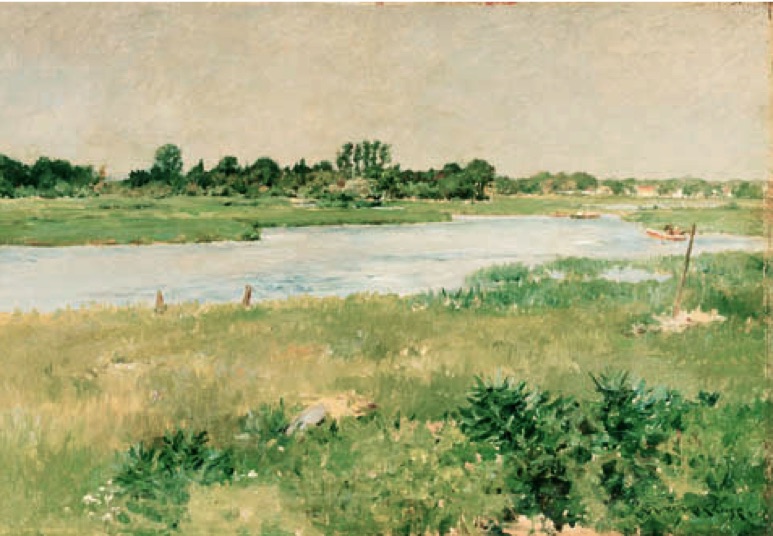
Salt marshes pictured in Chase’s painting (left) were destroyed when Shinnecock Creek was dredged, reshaped into the Canal. A practice repeated all along our Eastern coasts. (Excerpt from Long Island Sound Study, 2014) ”Since colonial times, humans have altered the Sound’s coastal habitats by concentrating housing, commerce, and recreation near the water...read more.

The Shinnecock Canal and two Bays it links are part of the Peconic Estuary (excerpt from a Report) 


According to Dr. Christopher J. Gobler, Professor Stony Brook School of Marine and Atmospheric Sciences, “salt marsh / shoreline modification may alter the natural biogeochemical and/or ecological functioning of estuarine ecosystem”....read more

Seagrasses are a type of submerged aquatic vegetation – plants which spend their entire lives under the waves.....Eelgrass once formed extensive, luxuriant undersea meadows throughout all of Long Island’s estuaries.  These meadows provided a variety of ecosystem services.  Eelgrass helps stabilize the sediments both by an extensive root and rhizome network, but also by the blades baffling water currents.  Seagrasses help maintain water quality through absorption of nutrients and carbon dioxide, and the release of oxygen.  They provide food to numerous species – locally, eelgrass is a part of the diet of many native and introduced water fowl.  But perhaps one of the most important services provided by eelgrass is as a shelter for many resident marine species, a nursery ground for migrant species and a foraging ground for larger species.  In fact, many of New York’s commercially and recreationally important marine fish species spend at least a portion of their lives utilizing eelgrass as a habitat.

For more info: 
Shinnecock Bay Restoration Program,  videos:  The Need to Restore Shinnecock Bay  Underwater video:  Seagrass
Brad Peterson Community Ecology Lab

Functions and Values of a Salt Marsh
Long Island South Shore Estuary Reserve
http://longislandsoundstudy.net/issues-actions/habitat-quality/http://longislandsoundstudy.net/issues-actions/habitat-quality/http://longislandsoundstudy.net/issues-actions/habitat-quality/http://www.somas.stonybrook.edu/people/gobler.htmlhttp://www.somas.stonybrook.edu/people/gobler.htmlhttp://www.somas.stonybrook.edu/research/highlights/Peterson/index.htmlhttp://www.somas.stonybrook.edu/research/highlights/Peterson/index.htmlhttp://www.somas.stonybrook.edu/research/highlights/Peterson/index.htmlhttp://www.somas.stonybrook.edu/research/highlights/Peterson/index.htmlhttp://www.somas.stonybrook.edu/research/highlights/Peterson/index.htmlhttp://www.somas.stonybrook.edu/research/highlights/Peterson/index.htmlhttp://www.somas.stonybrook.edu/research/highlights/Peterson/index.htmlhttp://www.somas.stonybrook.edu/research/highlights/Peterson/index.htmlhttp://www.somas.stonybrook.edu/research/highlights/Peterson/index.htmlhttp://www.somas.stonybrook.edu/research/highlights/Peterson/index.htmlhttp://www.somas.stonybrook.edu/research/highlights/Peterson/index.htmlhttp://www.somas.stonybrook.edu/research/highlights/Peterson/index.htmlhttp://www.shinnecockbay.org/multimedia/index.htmlhttp://www.shinnecockbay.org/multimedia/videos.htmlhttp://www.shinnecockbay.org/multimedia/videos-seagrass.htmlhttps://you.stonybrook.edu/theawesomepeterson/about-2/http://des.nh.gov/organization/commissioner/pip/factsheets/cp/documents/cp-07.pdfhttp://www.lisser.us/council-priorities/living-resources/salt-marshes.pdfshapeimage_1_link_0shapeimage_1_link_1shapeimage_1_link_2shapeimage_1_link_3shapeimage_1_link_4shapeimage_1_link_5shapeimage_1_link_6shapeimage_1_link_7shapeimage_1_link_8shapeimage_1_link_9shapeimage_1_link_10shapeimage_1_link_11shapeimage_1_link_12shapeimage_1_link_13shapeimage_1_link_14shapeimage_1_link_15shapeimage_1_link_16shapeimage_1_link_17shapeimage_1_link_18shapeimage_1_link_19shapeimage_1_link_20shapeimage_1_link_21shapeimage_1_link_22

William Merritt Chase

Shinnecock Landscape 

Oil  26.7 x 40.7 cm.

sketches 
of 
local history:
Shinnecock Canal Canoe Place 
  40°53′15″N 72°30′5″Whome_index.html
William Merritt Chase's vivid depictions of the Shinnecock Hills have been repeatedly acknowledged as some of the finest accomplishments of American Impressionism. Read more..
shinnecock_landscape_notes_christies.html

                   “There are many benefits to land protection, including preserving unique species and natural communities, controlling nitrogen loads to optimize dissolved oxygen in the water for fish and shellfish, and protecting surface water quality and groundwater recharge areas from other adverse effects.  In addition, the public has a strong attachment to the natural and amenity resources of the Peconic Estuary region, even if they do not use them directly or frequently. Ever-increasing development is consuming open space and natural habitat, and stressing watersheds and natural communities.  The region’s growing population and the significant increase in the rate of development in the last five years underscores the need for immediate action to protect the estimated 40% of acreage in the Peconic Estuary study area that still could be developed. read more...

copyright2015 Hope Sandrow